


Eos the Goddess of Dawn

Her Mythology, Her Nature, And What She Reveals About Transformation

Titan Who Drives The Dawn
Eos is a Titan goddess born to Hyperion and Theia, two of the ancient deities who ruled before Zeus and the Olympians came to power. She is the sister of Helios, the sun god, and Selene, the moon goddess, making her part of the primordial trinity that governs the movement of celestial light across the sky. While most Titans were overthrown when Zeus rose to dominance, Eos persisted into the new cosmic order not through defeat but through transformation, making her one of the few ancient gods whose power remained undiminished even as the world changed around her.
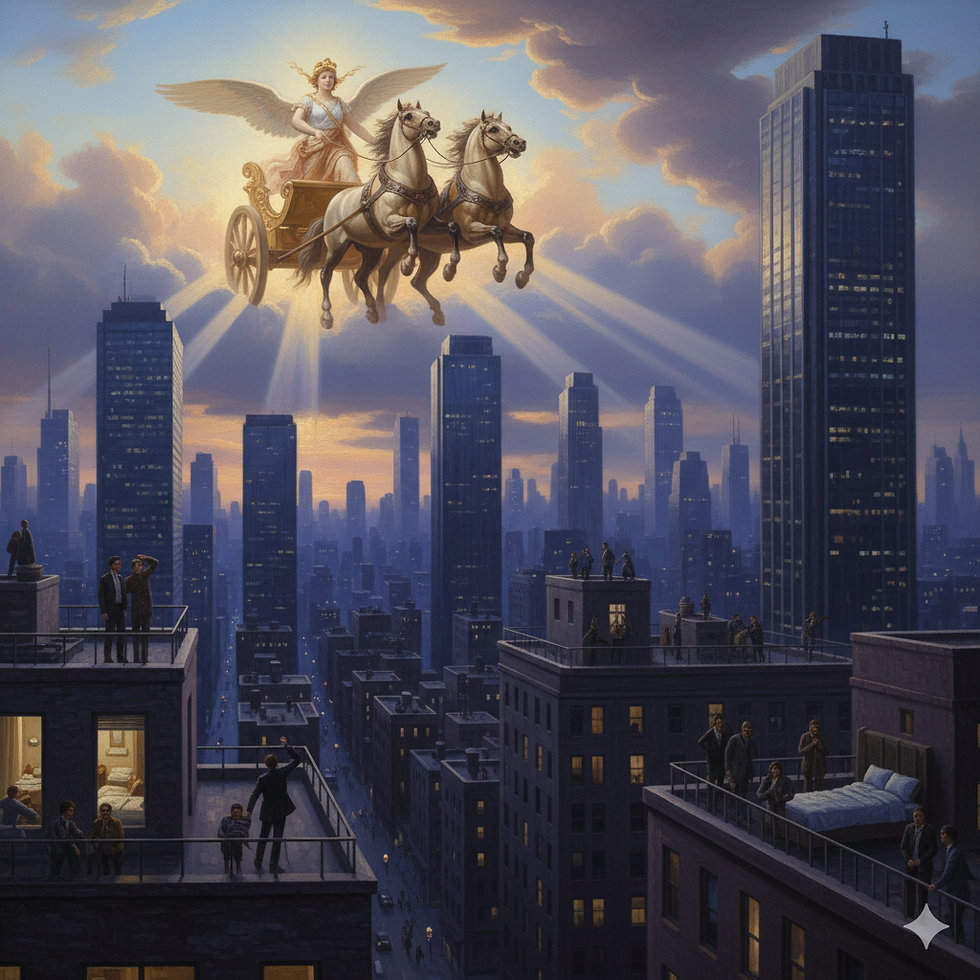
Every morning, Eos leaves her home at the edge of the ocean and drives her chariot across the sky pulled by two golden horses named Lampus and Phaethon, which mean light and brightness. As she travels, she spreads the light of dawn across the world, announcing the arrival of her brother Helios and preparing the universe for the day ahead. Homer calls her rosy fingered, describing the way her light touches everything gently and announces the coming sun with warmth and color. She appears in the epic tales as the one who brings the dawn, the one who marks the passage of time, the one who signals the transformation from night into day.
But the ancient myths hold a darker knowledge about Eos that the prettified versions hide because she is not simply the bringer of gentle light but rather a force of abduction and transformation, a goddess whose love is possessive and whose power comes with a cost that mortals pay in their flesh and their humanity.
The Abductions: Love And Possession
The most famous stories about Eos reveal her true nature as a goddess of violent desire and possession who did not follow the rules that bound other deities because she took what she wanted when she wanted it, and when the objects of her desire were mortal men, she took them from their beds and from their lives and from everything they knew. The myths do not present these as love stories but rather as abductions, which is precisely what they were, unapologetic seizures of human beings by a force that could not be denied or negotiated with.
One of her most famous abductions was of Tithonus, a mortal prince of Troy who was renowned for his beauty. Eos fell in love with him and could not bear the thought of losing him to death as all mortals must eventually die. She abducted him from his bed and carried him away to her palace. She then approached Zeus and asked him for a gift that would bind Tithonus to her eternally: immortality. Zeus granted her wish without hesitation, making Tithonus immortal. But Eos had made a fatal mistake in her request. She had asked Zeus for immortality but she had forgotten to ask for eternal youth.
Tithonus remained alive forever, but his body continued to age as all mortal bodies must because he grew old and feeble and weak while Eos remained eternally young and beautiful and unchanging beside him. Eventually his suffering became so unbearable that Eos transformed him into a grasshopper, a creature so small and voiceless that his endless immortal life became almost unnoticeable. The myth presents this not as an act of cruelty but as a mercy, a final transformation for a man who had become unrecognizable to himself, yet it is still a transformation imposed by Eos without consent, a complete erasure of his humanity in service to her inability to let him go.
This is the pattern of Eos's love because she possesses and she takes and she transforms the objects of her affection in ways that strip them of their humanity without regard for their wishes or their survival. She does this because she cannot tolerate loss and cannot tolerate the natural order of things where mortals age and die and leave her, making her a goddess of transition who paradoxically resists the transition that comes with letting go of what she loves.
The Goddess Who Resists Change
The Tithonus story reveals something essential about Eos's nature because she is the goddess of dawn, the harbinger of change, the force that marks the passage of time and the transformation of night into day, yet in her personal mythology she resists the change that affects her own beloved. She refuses to accept the natural order that would take her mortal lovers from her and she uses her divine power to circumvent death, to hold onto what she loves, to prevent the transformation that time demands even though she embodies that transformation.
This contradiction is not a weakness in the mythology but its core truth. Eos represents both the inevitability of transformation and the resistance to it. She heralds the dawn that brings change to all things, yet she struggles against the changes that threaten what she loves. She is the goddess who understands that dawn comes whether we are ready or not, yet she cannot accept the dawns that come for people she wishes to keep forever.
The mythology shows us another abduction, this one of Ares' lover, where Eos's desire again overrides all other considerations because she takes what she wants and she does not ask permission and she does not consider the objects of her affection as beings with their own agency or desires. She simply possesses them and takes them and transforms them into what she needs them to be in order to satisfy her own needs without regard for what they might have chosen for themselves.
The Transition Goddess And The Fear Of Loss
To understand Eos fully, we must understand that she is a Titan goddess of transition itself. She marks the moment when night becomes day, when one cycle ends and another begins. She announces the passage of time. She heralds change. Every day, she rides her chariot across the sky, signaling that what was is ending and what will be is arriving. This is her power and her domain. She is the goddess of every beginning that requires an ending.
Yet the myths show her struggling against the ultimate transition: the transition of death that comes for all mortals. She cannot accept that the people she loves must eventually die. She cannot tolerate the thought of losing them to time as she loses everyone else. So she uses her divine power to try to halt the transition that even she, as the goddess of transition, cannot prevent. She asks for immortality for her beloved Tithonus, trying to create an exception to the rule that governs all mortal existence.
The result is tragedy. She creates a fate worse than death: endless life without the vitality of youth, endless time without the ability to move forward. She transforms her beloved into something barely recognizable in order to solve the problem of loss. And still it is not enough. Still he suffers. Still she cannot have what she wants.
This is the shadow of Eos. She who marks the passage of time cannot accept the passage of time. She who heralds transformation cannot accept the transformations that take from her. She who demands that the world move forward, that the sun rise, that the night end, cannot accept that this same force will eventually end everything she loves.
Why Her Mythology Matters Now
The ancient stories about Eos are not simply historical tales about what gods did in the distant past. They are maps of archetypal patterns that repeat themselves in human consciousness and in the cosmos itself. Eos represents the force of inevitable transition, the truth that change comes whether we are ready or not, the reality that dawn arrives every morning and we cannot stop it no matter how much we want to sleep.
But her mythology also shows us the human response to inevitable change. We all resemble Eos in some way. We all understand the beauty of transitions and transformations while also fearing the loss that comes with them. We all want to hold onto what we love while knowing that time will eventually take it from us. We all have within us both the force that drives change and the resistance to change that protects what is precious to us.
The ancient Greeks understood something that modern culture tries to hide: that the same force that brings beauty and renewal also brings loss and destruction. The same dawn that brings light also ends the night. The same time that allows growth also brings aging. The same transformation that creates new possibilities also destroys old certainties.
Eos teaches us that these contradictions are not flaws in the cosmic order. They are the cosmic order itself. Change and preservation, loss and gain, the new and the old, all exist simultaneously. And we, like Eos, must learn to hold both truths at once without trying to make one disappear.
The Goddess We Meet In Times Of Change
Eos appears in mythology in moments of transition and transformation. She is invoked by warriors preparing for battle, by those facing the unknown, by anyone standing at the threshold between what was and what will be. Her presence is not comfortable. She does not offer comfort. She offers clarity about the reality that change is coming and we cannot stop it.
When Odysseus and his men prepared to face the Cyclops, they awaited Eos's coming to bring light to their darkness. When Achilles prepared for his final battle, he knew Eos would announce the day of his fate. When mortals faced their most difficult transitions, Eos appeared as the herald of what would come, the force that would drag them from darkness into light whether they were ready or not.
She appears in these myths not as a comforting presence but as an inevitable one because she is the force you cannot negotiate with and the change you cannot stop and the light that breaks through your darkness whether you want it to or not, making her the moment when you must stop sleeping and face what the new day brings.
Her mythology tells us that transformation is not optional and change is not something we choose because the dawn comes every morning and with it comes the necessity to awaken and to leave what we were and to step into what we are becoming. We can resist this and we can try to stay in the darkness, but Eos will come anyway because the sun will rise and the night will end and the transformation will happen with or without our consent.
The Return Of The Goddess
The ancient stories about Eos have largely faded from modern consciousness, replaced by depictions of dawn as something gentle and comforting, something that can be managed and controlled through proper morning routines and meditation apps and the right attitude, because modern culture has domesticated the goddess and made her safe and comfortable and optional.
But the mythology tells us something different because Eos is not safe and Eos is not optional and Eos is the force that comes whether we are ready or not, and she will abduct you from your comfortable bed and drag you from darkness into light and expose everything that was hidden in the night and demand that you transform and let go and move forward into whatever comes next.
She is returning now, not just mythologically but as an actual archetypal force moving through consciousness and through the world, because the Age of Pisces with its gentle passive accepting consciousness is ending and the Age of Aquarius is beginning with the energy of disruption and transformation and the refusal to accept the old order. Eos is here and she is riding her chariot and she is announcing the dawn of a new age.
The mythology teaches us that we cannot stop her and we cannot negotiate with her and we cannot meditate her into being more comfortable, so we can only choose to ride the light she brings or to resist it and be dragged along anyway.
Eos is not a gentle goddess and she is not kind because she does not ask permission or wait for you to be ready, instead she comes every morning and she tears open the darkness and demands that you wake up and face whatever the day brings. The ancient myths know this truth and they present her as a force to be reckoned with rather than as a comforting presence that asks for your consent before arriving.
Yet she is also absolutely necessary because without her there would be no light and without her there would be no transition from night to day and without her the world would remain frozen in darkness and stagnation indefinitely. She is terrible and she is essential, disruptive and necessary, a force that allows growth and change and the possibility of new beginnings precisely because she demands the rupture that transformation requires.
Her mythology teaches us that transformation requires rupture and change requires the ending of what was and growth requires loss because the dawn can only come if the night ends and Eos is the goddess who ensures that the night always ends, that the darkness always gives way to light, that transformation always arrives whether we are ready for it or not and whether we consent to it or resist it with all our strength.
Want to understand the archetypal forces moving through your life and through the world right now? Get your personal astrology reading at https://VibrationsByTash.com and learn what the current astrological transits reveal about your personal transformation and the collective awakening.
Follow Vibrations by Tash on Instagram at https://www.instagram.com/vibrationsbytash/ and on Twitter at https://x.com/VibesbyTash for daily insights about the goddess energy moving through your life.
Explore how essential oils can support you as you navigate major transitions and life changes by visiting https://VibrationsByTash.com and browsing the oil collection. Oils like frankincense and sandalwood create grounding and clarity during times of disruption. Find Vibrations by Tash on TikTok at https://www.tiktok.com/@vibrationsbytash and on Facebook at https://www.facebook.com/VibrationsbyTash for tips on using oils during transformation.
Share the mythology of Eos with others who are experiencing major life transitions at https://www.pinterest.com/vibrationsbytash. Let them know that what they are experiencing is not random chaos but part of an ancient and inevitable pattern that has repeated itself throughout human history and will continue to repeat. Visit https://VibrationsByTash.com for more mythology and guidance on navigating change.
© 2025 Vibrations by Tash Understanding the myths. Honoring the transformation. Supporting the dawn.


Comments