


Ginger, The Mars Oil for Inner Fire and Endurance

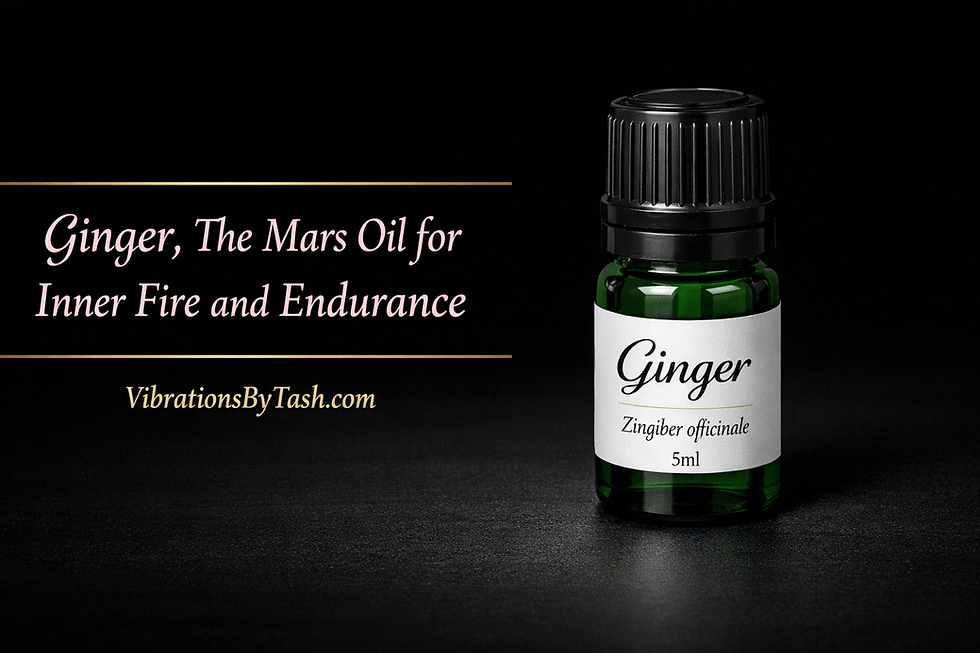
Not every Mars oil is a strike. Some of them are the heat that makes sustained effort possible, the warmth that keeps the system moving when the initial burst of activation has burned through and the work still needs to be done. Ginger is that oil in the Aries collection, and the distinction matters because Aries energy is not always about ignition. Sometimes it is about the endurance to keep moving after the first rush has passed, and ginger addresses that end of the Mars spectrum more directly than any other oil in this series.
What Ginger Actually Is
Ginger essential oil is derived from Zingiber officinale, a rhizomatous flowering plant belonging to the Zingiberaceae family, the same botanical family as cardamom and turmeric. The plant is native to Southeast Asia and has been cultivated and traded throughout Asia, the Middle East, and Europe for at least three thousand years, making it one of the most historically documented medicinal and culinary plants in the world. The essential oil is produced through steam distillation of the plant's rhizome, which is the underground stem structure more commonly referred to as the ginger root.
There is an important distinction between fresh ginger oil and dried ginger oil that has practical implications for aromatherapy use. Fresh ginger oil is distilled from the undried rhizome and tends to produce a lighter, more citrusy aromatic profile with a higher content of monoterpene compounds, particularly zingiberene and camphene. Dried ginger oil is distilled from the rhizome after it has been dried, which concentrates the sesquiterpene compounds and produces a deeper, warmer, more penetrating aromatic profile that is more strongly associated with the heating and circulatory effects documented in aromatherapy practice. For the Mars and Aries energy applications discussed in this series, dried ginger oil is the more relevant form, and reputable suppliers should specify which form they are offering.
The dominant chemical constituents of ginger essential oil include zingiberene, beta-bisabolene, and beta-sesquiphellandrene, which are sesquiterpene compounds that contribute to the oil's warming, grounding, and physically activating character.
The Culpeper Connection
Nicholas Culpeper assigned ginger to Mars in The English Physician (1652) on the basis of its heat, its action on the digestive system, and its association with physical endurance and the capacity to sustain effort. These are core Mars qualities in Culpeper's planetary taxonomy, and ginger delivers them with a consistency that justifies the assignment across both traditional herbalism and contemporary aromatherapy practice.
Where black pepper's Mars quality is the sharp, penetrating directness of immediate activation, ginger's Mars quality is the sustained warmth that keeps the body's systems moving over time. Culpeper recognized both as Martian because Mars governs not only the initial strike but the physical vitality that makes sustained action possible, and ginger addresses the latter more directly than almost any other oil in the collection. The assignment is clean, the reasoning is traceable, and the contemporary evidence base for ginger's documented effects is consistent with what Culpeper identified three and a half centuries ago.
Myth and Archetype
Black pepper carries the archetype of the spear, the single directed strike that penetrates precisely and immediately. Ginger carries a different and equally essential Mars quality, which is the sustained inner heat of the warrior in the field rather than the warrior at the moment of engagement. In ancient military contexts, the capacity to endure cold, fatigue, and the physical demands of a long campaign was understood as a Mars quality as much as the capacity to strike, and the herbs associated with generating and sustaining physical warmth were valued accordingly. Ginger's archetypal role in this series is the oil of the long campaign, the one that keeps the inner fire burning when the work requires persistence rather than ignition, and that distinction gives it a unique and irreplaceable position in the Aries collection alongside the more acutely activating oils.
What Ginger Actually Does in Aromatherapy
Ginger essential oil has a well-documented profile in contemporary aromatherapy that aligns closely with both its traditional Mars assignment and its practical position in the Aries oil collection. Its most widely studied application is in the area of nausea relief, where inhalation of ginger oil has been investigated in clinical contexts including postoperative nausea and pregnancy-related nausea, with results that are generally supportive of its effectiveness as a non-invasive aromatic intervention. This is one of the more robust evidence bases in the essential oil canon and gives ginger a documented application that extends beyond the circulatory and activating properties it shares with other Mars oils.
Its second major documented application is as a circulatory warming agent, where topical use of properly diluted ginger oil contributes to local warmth and blood flow stimulation. This application is the basis for its use in warming massage blends and in preparations intended to support physically fatigued or cold muscles. The warming effect of ginger differs from that of black pepper in character; ginger tends to produce a deeper, more sustained warmth, whereas black pepper's warming effect is sharper and more immediately penetrating.
Ginger also has documented applications for digestive support, where its warming and stimulating properties contribute to appetite stimulation, digestive comfort, and the relief of sluggish digestion. This application connects directly to its traditional use as a digestive herb across multiple medicinal traditions and to Culpeper's documentation of its action on the body's physical systems.
As with every oil in this series, ginger essential oil does not treat, cure, or prevent any medical condition, and the documented effects described here are aromatherapy applications rather than medical ones. I am not a doctor, and this is not medical advice.

How to Use Ginger Safely
Ginger essential oil is appropriate for home use when applied at proper dilutions, and the primary safety consideration is skin sensitization rather than any phototoxic risk, which does not apply to ginger oil. It is a warming oil and its constituent profile can produce skin irritation or redness in susceptible individuals at dilutions that would be unproblematic for most people, which is why starting conservatively and conducting a patch test before broader use is the responsible approach.
For topical application, use 1 to 2 drops of ginger essential oil per 10ml of carrier oil, producing a dilution of approximately half to one percent. Apply to the back of the neck, wrists, lower abdomen for digestive applications, or to tight and fatigued muscles for warming support. If you are using it for the first time or if you have a history of skin sensitivity, begin at the lower end of this range and assess your skin's response before increasing the concentration.
For diffusion, use 3 to 4 drops in a water-based diffuser for a standard room. Unlike some of the more acutely stimulating oils in this collection, ginger can be used at any time of day when its warming and grounding qualities are needed rather than being restricted to morning use only, though its circulatory stimulating properties make evening use around sleep time a consideration to be aware of. Diffuse for 30 to 45 minutes in a ventilated space.
Ginger essential oil does not carry a phototoxic risk and does not require sun avoidance after topical application in the way that expressed citrus oils do. It is not recommended for use in the bath for the same reason as most other essential oils: it does not disperse adequately in water and can cause skin irritation at the undiluted concentrations that result from direct contact with bathwater.
Who Should Approach Ginger With Caution
Ginger essential oil has a relatively favorable safety profile compared to several other oils in the Aries collection, but it is not without considerations.
People with sensitive or reactive skin should conduct a patch test and begin at the lower end of the dilution range, because the warming compounds in ginger can cause localized redness or irritation in susceptible individuals even at standard dilutions. This is a skin sensitization consideration rather than an allergic one in most cases, but it is worth taking seriously before applying the oil broadly.
People who are already in a state of excess physical heat, inflammation, or high activation should use ginger with awareness. Its warming and circulatory stimulating properties can compound existing heat in the system, and in those circumstances the more appropriate choice from the Aries collection may be juniper, which activates and clarifies without adding warmth to a system that already has more than enough.
Ginger essential oil's safety in pregnancy is nuanced. While ginger as a food and in tea is widely considered safe during pregnancy and is commonly recommended for pregnancy-related nausea, ginger essential oil in concentrated form is a different matter, and conservative aromatherapy practice recommends consulting a doctor before using it during pregnancy. The inhalation application for nausea has been studied in pregnancy contexts with generally positive findings, but professional guidance is appropriate before using any essential oil during that period.
I am not a doctor, and this is aromatherapy information rather than medical advice. Essential oils do not treat, cure, or prevent disease, and if you are managing a health condition or taking medications, consult your doctor before using ginger or any other essential oil.
How Ginger Fits the Aries Energy Profile
The Aries energy profile is most commonly discussed in terms of its initiating and activating qualities, but there is a second dimension to Mars energy that is less often addressed, which is the physical vitality and inner heat that sustain forward movement once it has begun. Ginger addresses that second dimension more directly than any other oil in this collection, and that specificity is what makes it irreplaceable within the series rather than a redundant warming oil alongside black pepper and rosemary.
When the Aries or Mars energy profile shows up as depletion, as a system that has initiated but run out of the inner warmth needed to continue, ginger is the appropriate oil in a way that black pepper is not. Black pepper ignites; ginger sustains. Rosemary activates and clarifies; ginger warms and endures. Thyme drives forward with vigorous force; ginger provides the steady heat beneath that force that makes it possible to maintain over time. Each of those roles is distinct, and ginger's role is the one that becomes most relevant when the work is long rather than sharp, when the Mars quality needed is not the spear thrust but the fire that keeps burning through the night.
Where to Find It
Ginger essential oil is available at VibrationsByTash.com/shop alongside the full collection of Aries series oils. For the complete guide to which Aries oils are worth using and why, including the safety filter and the full Culpeper Mars list, visit the main Aries essential oils post at VibrationsByTash.com.
Follow for more at @vibrationsbytash on Instagram and TikTok, or find us on Facebook at https://www.facebook.com/VibrationsbyTash and Pinterest at https://www.pinterest.com/vibrationsbytash for weekly content that cuts through the wellness industry noise.


Comments